
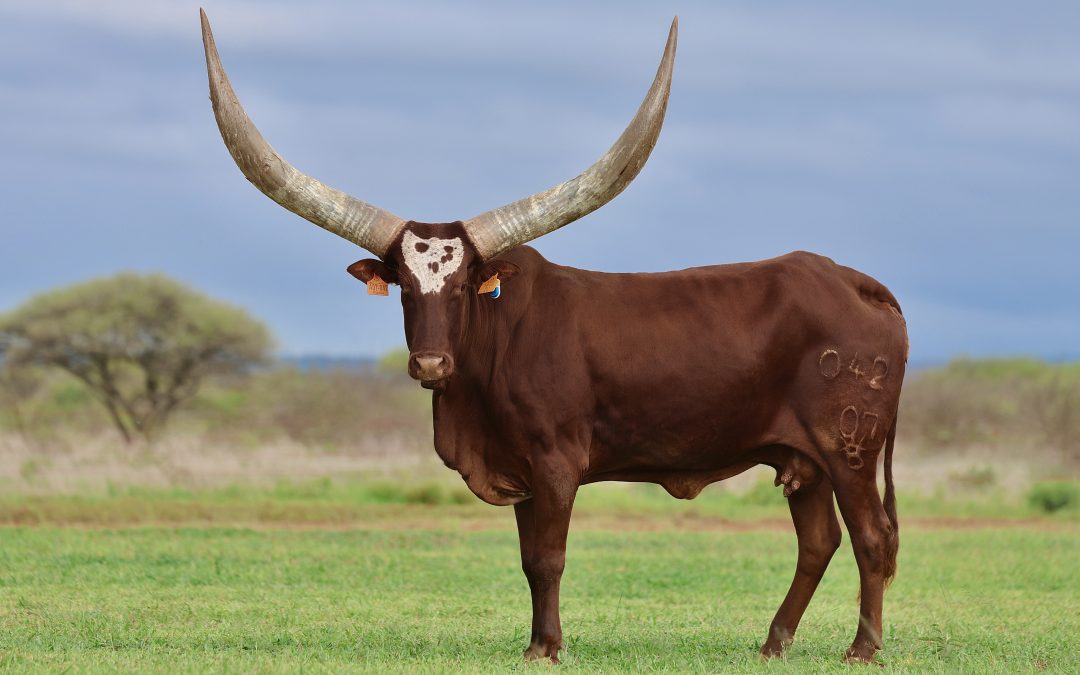
Kyasha – South-Africa’s Top Ankole Cow!
South African Ankole Top Cow Standard
Fire Sky Ankole Position Statement
In time we must standardise how we define elite as South African Ankole farmers. A national Ankole cow ranking system should never only reward horn length – it must reward cows that can breed other elite cows consistently. Trophy is non-negotiable, but repeatability is what defines the true value in a stud herd.
In our research we have identified 10 broad categories by which stud and commercial animals are typically scored by. Within the those categories the actual weighting per category varies significantly.
1. Horn Score / Trophy Index
- Horn Shape correctness (classic lyre / symmetrical arc / tip positioning)
- Horn diameter (base thickness)
- Horn length (tip-to-tip measured full in curve, not just spread)
- Horn colour (consistency, shine, dark tips etc)
- Horn balance relative to skull size
2. Breed Type Correctness
- Head expression (quiet feminine face / correct jaw structure)
- Neck length & femininity
- Body length and barrel capacity
- Back topline correctness
- Tail set & switch quality
- Skin tightness (important in Ankole for “polished” look)
3. Colour and Coat Pattern
- Genetic pattern desirability (red, chocolate, pearly white. Spatter patterns etc)
- Genetic pattern repeatability
- Uniqueness + market desirability (there ARE premium phenotype markets forming)
- Coat hair quality (shine, condition, evenness)
4. Reproductive Performance
- Age at first calving (consider natural or part of OPU program) (Must have 1 natural birth at 30 moths)
- Calving interval history (also consider OPU success)
- Conception rate consistency (Not yet available)
- Maternal traits (mothering ability, milk quality, calf weaning weights)
5. Fertility
- Reproductive soundness (palpation records / hormone balance assumptions)
- Longevity score (cows that stay productive past 10 years get premium score)
6. Genetic Merit / Genomic Value (VERY important going forward)
- Sire line and dam line strength (pure Ugandan genetic traceability)
- EBVs / genomic modelling once SA data pool is large enough
- Consistency of progeny phenotype (this separates flukes from foundation cows) (Same as Point 3)
- Known repetency for horn shape transmission
7. Commercial Utility
- Hardiness in veld conditions (parasite tolerance / feed conversion / heat tolerance)
- Stress recovery and temperament
- Movement and structural soundness (even foot scoring matters if scaling)
8. Calf Record Index
- Total value of progeny sold (auction & private treaty)
- Show/Champion offspring (Not yet)
- Export grade approval history going forward (big future premium) (Not yet)
9. National Benchmarking
- How she compares against the percentile of the national dataset:
- Horn diameter percentile
- Horn length percentile
- Reproductive performance percentile
- Genomic percentile (when we have a national panel)
10. Future Auction Excitement / Market Desirability Score
- Narrative value / brand marking potential
- Photogenic presence / marketing allure (yes this counts – heavily – especially for yearling heifer sales)
Realistically some of this data is not yet available and as it is not required for selection purposes by the Ankole Society it is likely that it won’t be available in the near future.
At Fire Sky Ankole we believe that South Africa is going to bifurcate into 2 markets:
- Commercial production herds
- Stud elite / trophy genetic herds
If we design our own standards correctly now, we should be able to align with future national standards.
Fire Sky Commercial: Trophy phenotype still matters strongly but fertility, longevity, veld conversion, material traits and breed reliability matters as well.
(this is more international sustainable breeding science direction)
Fire Sky Stud: Very strong trophy phenotype weighting, as this is where we believe Ankole economics actually will sit long term.
Here is a list of criteria we use at Fire Sky to rate the top Ankole cows in the SA national herd – balanced between beauty, breeding value, and commercial performance (not just photogenic horn length). And this is actually a very big deal in the Ankole world – because if South Africa becomes a reference market (and we will) – we need objective trophy phenotype an+ genotype + productivity scoring.
Simplicity wins in the beginning, especially if this becomes a national reference and has to be translated into judging/ auction pre-grading / breeder compliance.
So the 6 consolidated scoring categories at Fire Sky are:
- Horn Trophy Score (aggregated)
- Breed Type Correctness
- Colour / Coat Pattern Quality
- Reproductive Performance
- Genetic Merit / Genomic Value
- Market Desirability / Commercial Impact
SOUTH AFRICAN ANKOLE TOP COW SCORING STANDARD – v1.0
6 CATEGORY SCORING MATRIX
STUD ELITE CLASS (Total = 100 points)
| STUD ELITE | COMMERCIAL | |
| Category | Weight | Weight |
| 1. Horn Trophy score (aggregated) | 40 points | 30 points |
| 2. Breed Type Correctness | 15 points | 15 points |
| 3. Colour / Coat Pattern Quality | 10 points | 5 points |
| 4. Reproductive Performance | 10 points | 20 points |
| 5. Genetic Merit/Genomic Value | 15 points | 15 points |
| 6. Market Desirability (Brand and Realised Value blended) | 10 points | 15 points |
To optimise weighting inside the Market Desirability category we note the following:
Brand and realised value blend is how elite genetics markets actually behave (Wagyu, Arabian horses, Texas Longhorns, elite Boran lines etc).
It also makes younger cows with no long sale history still competitive IF they have monster brand trajectory potential.
Stud Elite needs to clearly differentiate at the top end based on trophy phenotype. Fire Sky is going to become the top trophy brand in Ankole.
Commercial still rewards horns highest – but production traits together now surpass horns in combined influence.
This protects the breed from drifting into “trophy-only echo chamber” while keeping Ankole distinct.